
Report an issue
Tell us what's wrong and we'll take a look.
Thanks – we got it. We'll review and follow up if needed.


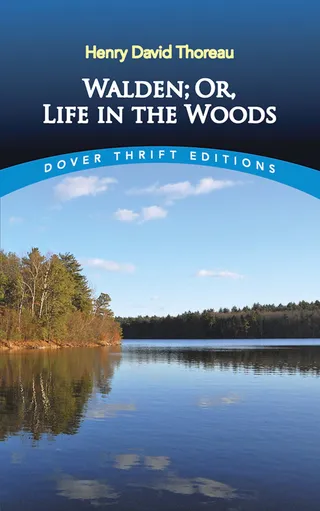
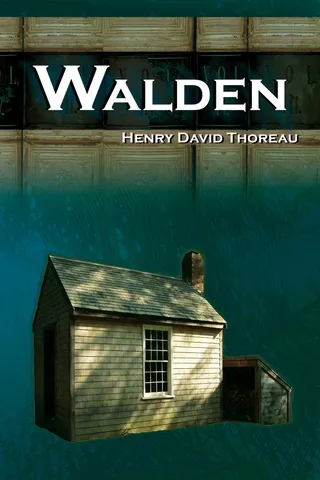
In Walden, Thoreau describes his experiences over two years, two months, and two days in a cabin he constructed close to Walden Pond amid Ralph Waldo Emerson's property near Concord, Massachusetts.
Thoreau makes precise scientific observations of nature as well as metaphorical and poetic uses of natural phenomena. He identifies many plants and animals by both their popular and scientific names, records in detail the color and clarity of different bodies of water, precisely dates and describes the freezing and thawing of the pond, and recounts his experiments to measure the depth and shape of the bottom of the supposedly "bottomless" Walden Pond.
There has been much speculation as to why Thoreau went to live at the pond in the first place. E. B. White stated on this note, "Henry went forth to battle when he took to the woods, and Walden is the report of a man torn by two powerful and opposing drives-the desire to enjoy the world and the urge to set the world straight," while Leo Marx noted that Thoreau's stay at Walden Pond was an experiment based on his teacher Emerson's "method and of nature" and that it was a "report of an experiment in transcendental pastoralism."
Henry David Thoreau
Henry David Thoreau (1817–1862) was an American author and naturalist. A leading figure of Transcendentalism, he is best remembered for Walden, an account of the two years he spent living in a cabin on the north shore of Walden Pond in Concord, Massachusetts, and for Civil Disobedience, an essay that greatly influenced the abolitionist movement and the teachings of Mahatma Gandhi and Martin Luther King Jr.
More by Henry David Thoreau




Why Readwise Books?
Readwise Books is an ebook & audiobook platform that automatically logs how much you and your friends read, making it fun and easy to read more. Learn more →