Report an issue
Tell us what's wrong and we'll take a look.
Thanks – we got it. We'll review and follow up if needed.
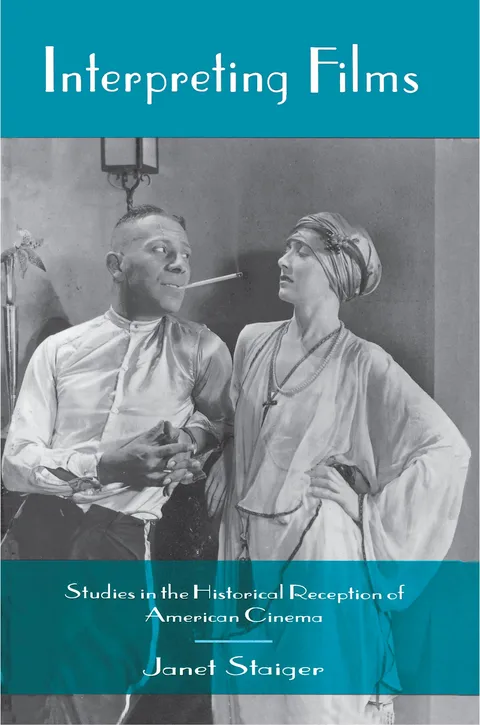
Employing a wide range of examples from Uncle Tom's Cabin and Birth of a Nation to Zelig and Personal Best, Janet Staiger argues that a historical examination of spectators' responses to films can make a valuable contribution to the history, criticism, and philosophy of cultural products. She maintains that as artifacts, films do not contain immanent meanings, that differences among interpretations have historical bases, and that these variations are due to social, political, and economic conditions as well as the viewers' constructed images of themselves. After proposing a theory of reception study, the author demonstrates its application mainly through analyzing the varying responses of audiences to certain films at specific moments in history. Staiger gives special attention to how questions of class, gender, sexual preference, race, and ethnicity enter into film viewers' interpretations. Her analysis reflects recent developments in post-structuralism, cognitive psychology, psychoanalysis, and cultural studies, and includes a discussion of current reader-response models in literary and film studies as well as an alternative approach for thinking about historical readers and spectators.
Janet Staiger
Janet Staiger teaches cultural, gender, sexuality, and media studies at The University of Texas at Austin. Her recent books are Perverse Spectators: The Practices of Film Reception and Blockbuster TV: Must-See Sitcoms in the Network Era (both available from NYU Press).
More by Janet Staiger














Why Readwise Books?
Readwise Books is an ebook & audiobook platform that automatically logs how much you and your friends read, making it fun and easy to read more. Learn more →