Report an issue
Tell us what's wrong and we'll take a look.
Thanks – we got it. We'll review and follow up if needed.
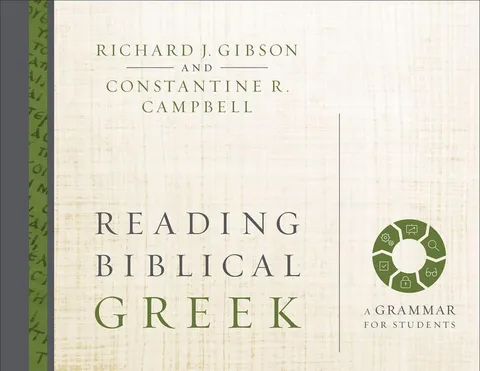
Reading Biblical Greek introduces first-year Greek students to the essential information needed to optimize their grasp of the fundamentals of the Greek language--no more and no less--enabling them to read and translate the Greek of the New Testament as soon as possible.
The learning approach in Reading Biblical Greek revolves around three core elements: grammar, vocabulary, and reading & translation.
- Grammar. The grammar consists of micro-lessons, which break up information in small, digestible chunks. Each micro-lesson addresses a single point. This arrangement makes for easy comprehension and review. It also allows the teacher to pace the material based on its difficulty and ability of their students. New learning is incremental and recursive--each new piece builds on and reinforces prior learning. Lessons are structured in three columns: 1) Introducing new topic; 2) Material to be memorized; and 3) Examples and exercises.
- Vocabulary. As an essential complement to grammar, vocabulary is introduced at strategic points and is arranged first by what the student has been learning in grammar, and then by frequency. The vocabulary lists are collated at the back of the book for easy access. The first 13 vocabulary lists are keyed to Mark 1-4 to help students to integrate their vocabulary learning with a "real" Greek text.
- Reading & Translation. The goal of this grammar is to enable students to read and translate the Greek of the New Testament. Thus, the content is structured and tied to a specific Greek text to enable reading as soon as possible. The student will have read and translated the whole of Mark 1-4 by the end of the course. The accompanying Reading Biblical Greek Workbook is a vital part of the approach. It breaks up the text of Mark 1-4 into manageable portions and provides vocabulary and grammatical assistance as required.
While Reading Biblical Greek only introduces students to information that is essential to grasp of the fundamentals of the Greek language, it is informed by the latest and best of Greek and linguistic scholarship, enabling students to move seamlessly to further study.
Richard J Gibson
Richard J. Gibson (PhD, Macquarie University) is Principal of Brisbane School of Theology in Australia. He has had twenty years of experience of teaching Greek, New Testament, church history and preaching at Moore Theological College in Sydney, Australia.
More by Richard J Gibson
Constantine R Campbell
Constantine R. Campbell (PhD, Macquarie University; PhD, Australian National University) is the author of several books on the New Testament and Ancient Greek, including Paul and Union with Christ—the 2014 Christianity Today Book of the Year in Biblical Studies. He is Professor and Research Director at the Australian University College of Divinity, and was previously Professor of New Testament at Trinity Evangelical Divinity School (Illinois) and senior lecturer in New Testament at Moore Theological College (Sydney). Dr Campbell lives in Canberra, Australia.
More by Constantine R Campbell




Why Readwise Books?
Readwise Books is an ebook & audiobook platform that automatically logs how much you and your friends read, making it fun and easy to read more. Learn more →