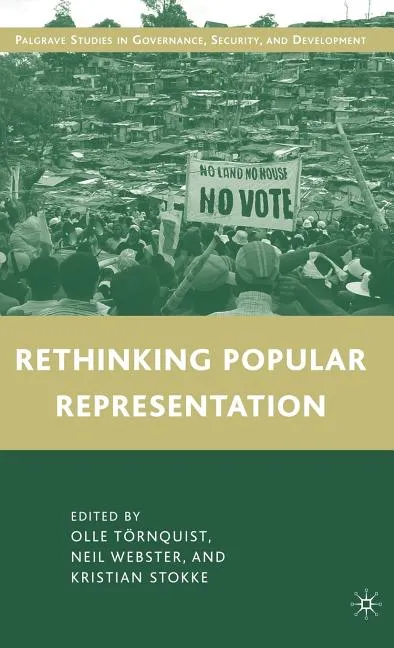
Rethinking Popular Representation
Report an issue
Tell us what's wrong and we'll take a look.
Thanks – we got it. We'll review and follow up if needed.
This book starts out from the deep concern with contemporary tendencies towards depoliticisation of public issues and popular interests and makes a case for rethinking more democratic popular representation. It outlines a framework for popular representation, examines key issues and experiences and provides a policy-oriented conclusion.
Noah Webster
American lexicographer, textbook pioneer, English-language spelling reformer, political writer, editor, and novelist Noah Webster Jr. lived from October 16, 1758, to May 28, 1843. The "Father of American Scholarship and Education" is how some have referred to him. He taught spelling and reading to five generations of American children using his "Blue-backed Speller" books. In the United States, the word "dictionary" has come to be associated with Webster's name, particularly with the contemporary Merriam-Webster dictionary, which debuted in 1828 as an American Dictionary of the English Language. Webster, who was born in West Hartford, Connecticut, earned his Yale College degree in 1778. After studying law under Oliver Ellsworth and others, he passed the bar test but could not get a job as a lawyer. By starting a private school and penning a number of instructional publications, such as "Blue-Backed Speller," he was able to achieve some financial success. Webster, who was a fervent advocate of the American Revolution and the passage of the US Constitution, later complained that American society lacked an intellectual basis. Because American ideals were superior, he thought that American nationalism was superior to that of Europe.


Why Readwise Books?
Readwise Books is an ebook & audiobook platform that automatically logs how much you and your friends read, making it fun and easy to read more. Learn more →