Report an issue
Tell us what's wrong and we'll take a look.
Thanks – we got it. We'll review and follow up if needed.
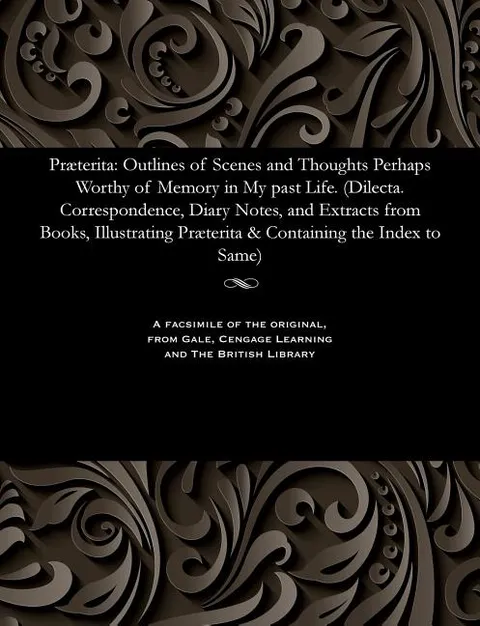
As a memoir elevated to the level of fine art, John Ruskin’s Praeterita stands alongside The Education of Henry Adams and the confessions of Augustine, Rousseau, and Tolstoy. A luminous account of his childhood and youth, Praeterita is the last major work of the revolutionary nineteenth-century critic.
Written in the lucid intervals between the bouts of dementia that haunted his final years, Praeterita tells the story of Ruskin’s early life—the formation of his taste and intellect through education, travels in Europe, and encounters with great works of art and artists. In abandoning the traditional linear mode of autobiography, Ruskin opened up the form and was an important influence on Proust. He also provided a vivid, detailed portrait of pre-Victorian and Victorian England that is as indispensable an account of its era as Samuel Pepys’s diary is of England in the seventeenth century.
This edition of Praeterita is accompanied by Dilecta, Ruskin’s own selection from his letters, diaries, and other writings. In these more private writings we get a fascinating glimpse of genius as it flickers in and out of madness. Together these two works illuminate the life and mind of a towering intellect who left an extraordinary mark on the history of aesthetics and culture, and on the very course of autobiography. With a new Introduction by Tim Hilton
John Ruskin
John Ruskin was an English writer, philosopher, art critic, and polymath during the Victorian era. He lived from 8 February 1819 to 20 January 1900. He published on a wide range of topics, including political economy, myth, ornithology, literature, education, and geology. Ruskin was very interested in Viollet le Duc's work, especially his Dictionary, which he regarded to be "the only book of any value on architecture." He taught it to all of his students, including William Morris. Ruskin used a variety of literary genres and writing styles. In addition to articles and treatises, he also published poems, lectures, travel instructions, correspondence, and even a fairy tale. Additionally, he created in-depth drawings and paintings of decorations, landscapes, birds, plants, and rocks. His early writings on art were written in an ornate style that eventually gave way to simpler language that served to better convey his ideas. He highlighted the links between nature, art, and society in all of his writing.
More by John Ruskin




Why Readwise Books?
Readwise Books is an ebook & audiobook platform that automatically logs how much you and your friends read, making it fun and easy to read more. Learn more →