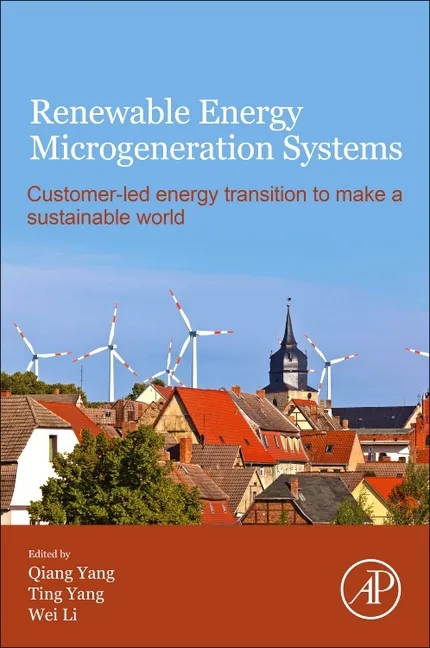
Renewable Energy Microgeneration Systems
Customer-Led Energy Transition to Make a Sustainable World
Report an issue
Tell us what's wrong and we'll take a look.
Thanks – we got it. We'll review and follow up if needed.
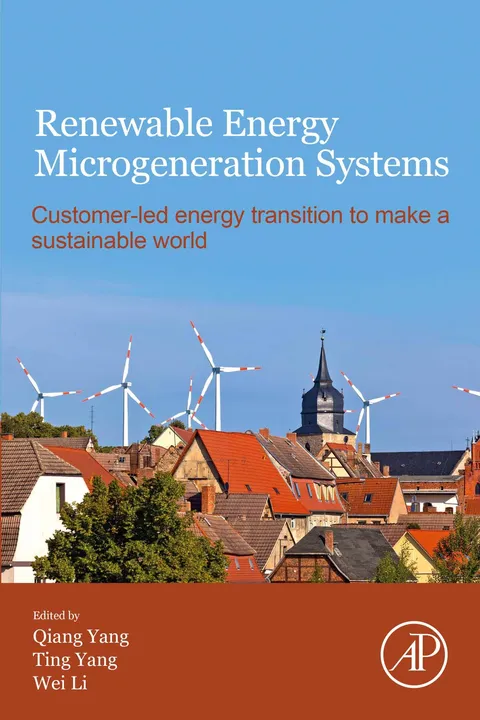
Renewable Energy Microgeneration Systems presents the latest technology advances in small-scale energy generation (electricity and heat) in the context of low/medium voltage level electric power distribution networks. With a focus on scientific innovations of the methodologies, approaches and algorithms in enabling efficient and secure operation of microgeneration systems, this book also analyzes the current understanding of motivations and barriers affecting microgeneration adoption with the aim of identifying opportunities for improving the field deployment.
Considering the recent advances of theories and implementations in modeling, design, planning and management of different forms of microgeneration systems, this reference provides applied researchers in the field of electrical engineering and renewable micro generation incredible insights into microgeneration systems technologies and the potential for new technologies and markets.
Qiang Yang
Dr. Qiang Yang obtained the BS degree (first class honors) in Electrical Engineering in 2001, and received the M.Sc. (with distinction) and Ph.D. degree both in Electronic Engineering and Computer Science from Queen Mary, University of London, London, U.K., in 2003 and 2007, respectively. He has worked as a Postdoctoral Research Associate at the Department of Electrical and Electronic Engineering, Imperial College London, U.K., from 2007 to 2010 and involved in a number of high-profile U.K. EPSRC and European IST research projects. Currently he is an Associate Professor at College of Electrical Engineering, Zhejiang University, China, and has published more than 100 technical papers, co-authored 2 books and holds 5 national patents. His research interests over the years include communication networks, smart energy systems, and large-scale complex network modeling, control, optimization, and simulation. He is the member of various international academic bodies including IEEE, IET and IEICE as well as the Senior Member of China Computer Federation (CCF).
Ting Yang
Dr. Ting Yang is currently a Chair professor of Electrical Theory and Advanced Technology, at the School of Electrical Engineering and Automation, Tianjin University, China. He was the cooperative research staff of Imperial College London (2008); visiting professor of University of Sydney, Australia (2015). Prof. Yang is the winner of the "New Century Excellent Talents in University Award" from Chinese Ministry of Education. He is the leader of tens of research grant projects, including the International S&T Cooperation Program of China, the National High-Tech Research and Development Program of China (863 Program), the National Natural Science Foundation of China, and so on. Prof. Yang is the chairman of two workshops of IEEE International Conference, and the editor in Chief of one of Special Issues of the international journal of DSN. He is the author/co-author of four books, more than one hundred publications in internationally refereed journals and conferences. Prof. Yang is a senior member of the Chinese Institute of Electronic, the fellow of Circuit and System committee, the fellow of Theory and Advanced Technology of Electrical Engineering, and the member of International Society for Industry and Applied Mathematics. His research fields include Smart Grid, advanced metering infrastructure, and information and communication technologies in electric power system.
Wei Li
Wei Li is an associate professor at Institute of Computing Technology, Chinese Academy of Sciences. Her research covers high-performance intelligent computing system. She has participated in several National Key R&D Projects, etc. As a core member, she has participated in the R&D of several deep learning processors. She has published around 30 academic papers, and applied for nearly 20 patents.


Why Readwise Books?
Readwise Books is an ebook & audiobook platform that automatically logs how much you and your friends read, making it fun and easy to read more. Learn more →