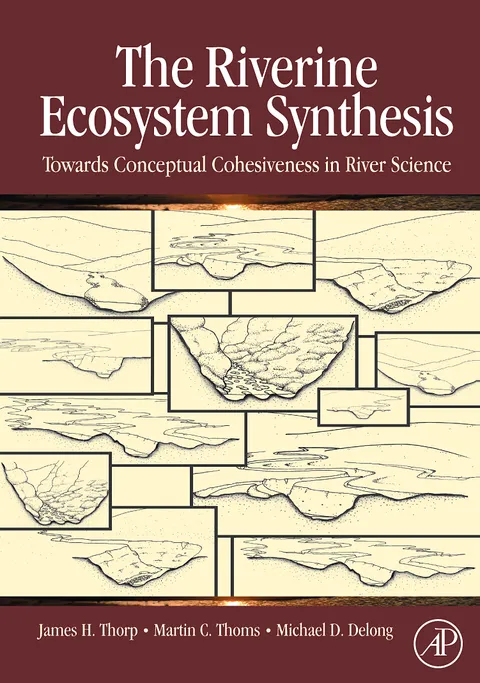
The Riverine Ecosystem Synthesis
Toward Conceptual Cohesiveness in River Science
Report an issue
Tell us what's wrong and we'll take a look.
Thanks – we got it. We'll review and follow up if needed.
This book presents the most comprehensive model yet for describing the structure and functioning of running freshwater ecosystems. Riverine Ecosystems Synthesis (RES) is a result of combining several theories published in recent decades, dealing with aquatic and terrestrial systems. New analyses are fused with a variety of new perspectives on how river network ecosystems are structured and function, and how they change along longitudinal, lateral, and temporal dimensions. Among these novel perspectives is a dramatically new view of the role of hydrogeomorphic forces in forming functional process zones from headwaters to the mouths of great rivers.
Designed as a useful tool for aquatic scientists worldwide whether they work on small streams or great rivers and in forested or semi-arid regions, this book will provide a means for scientists to understand the fundamental and applied aspects of rivers in general and includes a practical guide and protocols for analyzing individual rivers. Specific examples of rivers in at least four continents (Africa, Australia, Europe and North America) serve to illustrate the power and utility of the RES concept.
- Develops the classic, seminal article in River Research and Applications, "A Model of Biocomplexity in River Networks Across Space and Time" which introduced the RES concept for the first time
- A guide to the practical analysis of individual rivers, extending its use from pristine ecosystems to modern, human-modified rivers
- An essential aid both to the study fundamental and applied aspects of rivers, such as rehabilitation, management, monitoring, assessment, and flow manipulation of networks
James H. Thorp
Dr. James H. Thorp is an emeritus professor and senior scientist at the University of Kansas (Lawrence, KS, United States). Prior to 2001, he was a distinguished professor and dean at Clarkson University, department chair and professor at the University of Louisville, associate professor and director of the Calder Ecology Center at Fordham University, and research ecologist at Georgia's Savannah River Ecology Laboratory. He received his Baccalaureate from the University of Kansas and Masters and PhD degrees from North Carolina State. Prof. Thorp has been on the editorial board of three freshwater journals and is a former president of the International Society for River Science. His research interests run the gamut from organismal biology to community, ecosystem, and macrosystem ecology. While his research emphasizes aquatic invertebrates, he also studies fish ecology, especially food webs related. He has published more than 150 research articles and 120 books, including five volumes so far in the fourth edition of Thorp and Covich's Freshwater Invertebrates.
More by James H. Thorp

Martin C. Thoms
Martin Thoms is Professor of River Science and Chair of Geography and Planning at the University of New England, Armidale, Australia. His research activities focus on the boundaries of river science - boundaries between different disciplines (geomorphology-hydrology-ecology-biogeochemistry), the science-management-policy boundary and the boundaries between rivers and their floodplains. His research in this domain has occurred in both national and international settings. He is currently Regional Editor for River Research and Applications, on the editorial board of four other international journals and has been President of the International Society for River Science.


Why Readwise Books?
Readwise Books is an ebook & audiobook platform that automatically logs how much you and your friends read, making it fun and easy to read more. Learn more →