Report an issue
Tell us what's wrong and we'll take a look.
Thanks – we got it. We'll review and follow up if needed.


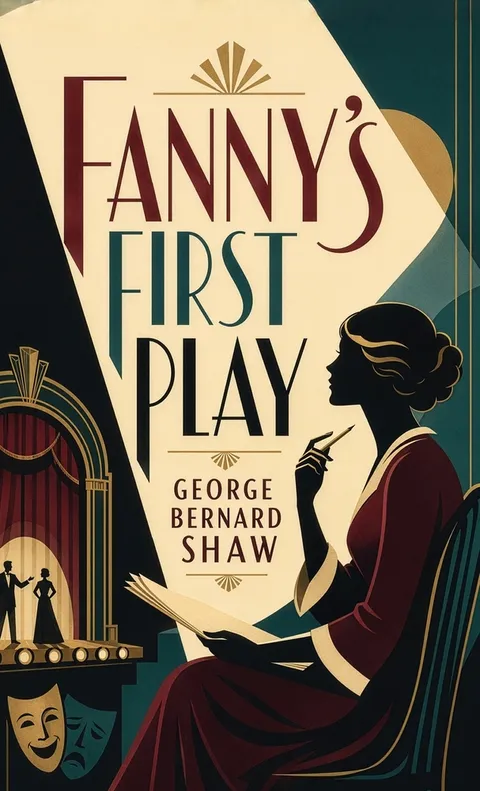
A young woman has written her first play. Her father has invited some of London's leading theater critics to see it. There's only one condition: they aren't allowed to know who wrote it.
That is the mischievous frame George Bernard Shaw constructs for Fanny's First Play, a comedy that turns its attention not only toward respectable society but toward the theatrical world responsible for judging how society is represented onstage.
Fanny O'Dowda has secretly written a play, and her father arranges a private performance before a group of professional critics. What they watch is a comedy involving two conventionally respectable families, the Gilbeys and the Knoxes, whose confidence in proper upbringing and social morality is about to receive a severe test.
The younger generation has been misbehaving. Bobby Gilbey has encountered a young woman whose reputation makes her unacceptable to respectable society, while Margaret Knox has returned home with experiences her parents could scarcely have imagined. As uncomfortable truths emerge, Shaw overturns easy distinctions between respectable and disreputable people. Those who appear scandalous may possess honesty and generosity; those most certain of their moral superiority may understand remarkably little about either morality or their own children.
Through these collisions, Shaw takes aim at conventional upbringing, class prejudice, sexual double standards, parental authority, and the peculiar social machinery by which reputations are created and defended. The comedy repeatedly asks whether respectable behavior is the same thing as good behavior-and what happens when young people discover that the rules their parents taught them bear little resemblance to the world they actually inhabit.
But Shaw has another target waiting outside Fanny's play. When the performance ends, the invited critics begin assessing what they have seen and speculating about the mysterious playwright's identity. Their judgments transform the framing story into a satire of theatrical criticism itself, allowing Shaw to poke fun at the habits, assumptions, rivalries, and certainties of those who make their living explaining drama to everyone else.
First performed anonymously in 1911, Fanny's First Play adds another layer to the joke: its original audiences were themselves invited to speculate about the identity of the unnamed playwright. Shaw thus creates a comedy about respectability and rebellion inside another comedy about authorship, criticism, and the theater.
Funny, self-aware, and deliberately irreverent, Fanny's First Play exposes the unstable boundary between respectable appearances and actual character. Parents judge children, society judges outsiders, critics judge playwrights-and Shaw quietly arranges matters so that the people most confident in their judgments often have the most to learn.
Bernard Shaw
From 26 July 1856 to 2 November 1950, Irish playwright, critic, polemicist, and political activist George Bernard Shaw was alive. He preferred to be referred to simply as Bernard Shaw. From the 1880s until his death and even after, he had a significant impact on Western politics, theater, and society. He produced more than sixty plays, including classics like Saint Joan (1913), Pygmalion (1913), and Man and Superman (1902). (1923). Shaw became a well-known playwright during his time and was awarded the Nobel Prize in literature in 1925 for his works that combine historical allegory and contemporary satire. Before Shaw's first play, Arms and the Man, published in 1894, became a success in the public eye, years passed. He tried to infuse new realism into English-language drama, influenced by Henrik Ibsen. He had established himself as a reputable theater and music critic by the mid-1880s. After having a political awakening, he joined the gradualist Fabian Society and swiftly advanced to the position of principal pamphleteer. Before Shaw's first play, Arms and the Man, published in 1894, became a success in the public eye, years passed. He tried to infuse new realism into English-language drama, influenced by Henrik Ibsen.
More by Bernard Shaw











Why Readwise Books?
Readwise Books is an ebook & audiobook platform that automatically logs how much you and your friends read, making it fun and easy to read more. Learn more →