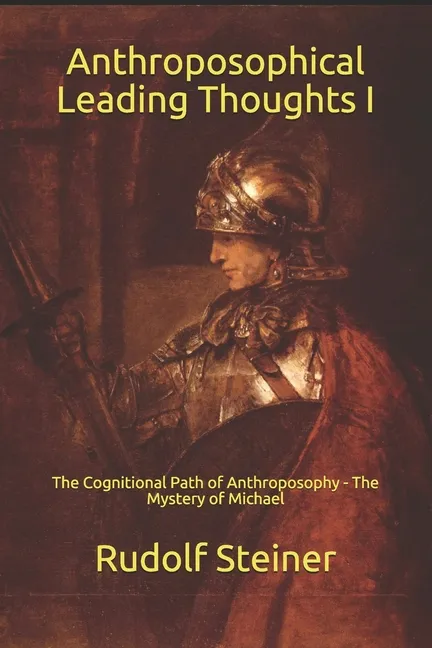
Anthroposophical Leading Thoughts I
The Cognitional Path of Anthroposophy - The Mystery of Michael
Report an issue
Tell us what's wrong and we'll take a look.
Thanks – we got it. We'll review and follow up if needed.
This is one of Steiner's very most important books. Written on what would turn out to be his deathbed, it contains summaries of all of anthroposophy in the lapidary form of epigrams. This is the first of seven volumes. Steiner sought to reorganize and re-energize the Society in the aftermath of the Christmas Conference held in 1923/1924. The aphorisms contained herein were one way of making possible a kind of "concerted action" guided by the Goetheanum. A few highlights: First we must realize that the world cannot ever answer the question who we are; it can only destroy us. To answer that question ultimately, we have to develop Imagination, Inspiration, and Intuition. Deep insight into human nature is provided when we view ourselves "pictorially," like a picture being at first intuited by the painter, and only becoming of finished painting after a long imaginative and inspired process. The volume includes two appendices, with selections from The Life, Nature, and Cultivation of Anthroposophy, and Carl Unger's marvelous reflections on the Leading Thoughts in aphoristic form.
Rudolf Steiner
Rudolf Steiner (1861-1925) was born in the small village of Kraljevec, Austro-Hungarian Empire (now in Croatia), where he grew up. As a young man, he lived in Weimar and Berlin, where he became a well-published scientific, literary, and philosophical scholar, known especially for his work with Goethe's scientific writings. At the beginning of the twentieth century, he began to develop his early philosophical principles into an approach to systematic research into psychological and spiritual phenomena. Formally beginning his spiritual teaching career under the auspices of the Theosophical Society, Steiner came to use the term Anthroposophy (and spiritual science) for his philosophy, spiritual research, and findings. The influence of Steiner's multifaceted genius has led to innovative and holistic approaches in medicine, various therapies, philosophy, religious renewal, Waldorf education, education for special needs, threefold economics, biodynamic agriculture, Goethean science, architecture, and the arts of drama, speech, and eurythmy. In 1924, Rudolf Steiner founded the General Anthroposophical Society, which today has branches throughout the world. He died in Dornach, Switzerland.
More by Rudolf Steiner




Why Readwise Books?
Readwise Books is an ebook & audiobook platform that automatically logs how much you and your friends read, making it fun and easy to read more. Learn more →