Report an issue
Tell us what's wrong and we'll take a look.
Thanks – we got it. We'll review and follow up if needed.
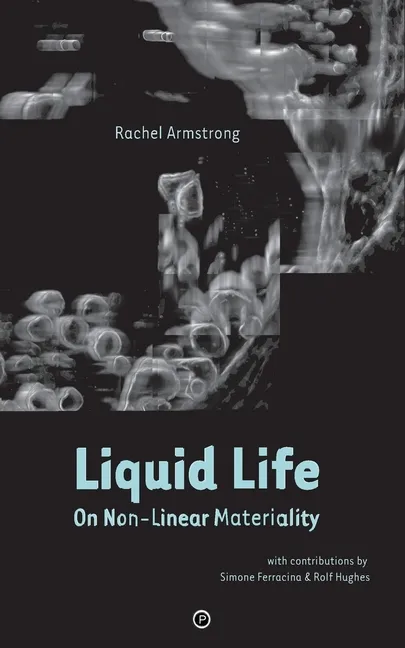
Liquid life references a third-millennial understanding of matter that seeks to restore the agency of the liquid soul for an ecological era, which has been banished by reductionist, "brute" materialist discourses and mechanical models of life. Offering an alternative worldview of the living realm through a "new materialist" and "liquid" study of matter, it conjures forth examples of creatures that do not obey mechanistic concepts like predictability, efficiency, and rationality. With the advent of molecular science, an increasingly persuasive ontology of liquid technologies can be identified. Through the lens of lifelike dynamic droplets, the agency for these systems exists at the interfaces between different fields of matter/energy that respond to highly local effects, with no need for a central organizing system.
Liquid Life seeks an alternative partnership between humanity and the natural world. It provokes a re-invention of the languages of the living realm to open up alternative spaces for exploration: Rolf Hughes' "angelology" of language explores the transformative invocations of prose poetry, and Simone Ferracina's graphical notations help shape our concepts of metabolism, upcycling, and designing with fluids. A conceptual and practical toolset for thinking and designing, Liquid Life reunites us with the irreducible "soul substance" of living things, which will neither be simply "solved," nor go away.
Rachel Armstrong is Professor of Experimental Architecture at Newcastle University (UK), and has also been a Rising Waters II Fellow for the Robert Rauschenberg Foundation (April-May 2016), TWOTY futurist in 2015, Fellow of the British Interplanetary Society, and a Senior TED Fellow in 2010. She is also the coordinator of the Living Architecture project, an EU-funded project that establishes the principles for our buildings to share some of the properties of living things, e.g. metabolism, operating at the intersection of architecture, building construction, bio-energy and synthetic biology. She is also the author of Vibrant Architecture (De Gruyter, 2015), Star Ark: A Living, Self-Sustaining Spaceship (Springer, 2017), and Soft Living Architecture: An Alternative View of Bio-informed Design Practice (Bloomsbury, 2018).
Rachel Armstrong
Rachel Armstrong is a writer of contemporary romantic fiction ranging from rural to suspense. She creates epic feel-good stories and has a weakness for an adventurous holiday escape.
Rachel lives with her border collie, Jacob, in Townsville, Queensland, where she rehabilitates hearts as an exercise physiologist. In her spare time, she is either reading on the treadmill or plotting her next novel at yoga. Rachel's a keen traveller and has enjoyed many holidays exploring historic London, flying through the Grand Canyon, and hiking volcanos in Bali.
Rachel loves to connect with readers and fellow writers through Facebook, Twitter, Instagram, and on her website.
Photograph Credit: Michelle Harms Photography
More by Rachel Armstrong








Why Readwise Books?
Readwise Books is an ebook & audiobook platform that automatically logs how much you and your friends read, making it fun and easy to read more. Learn more →