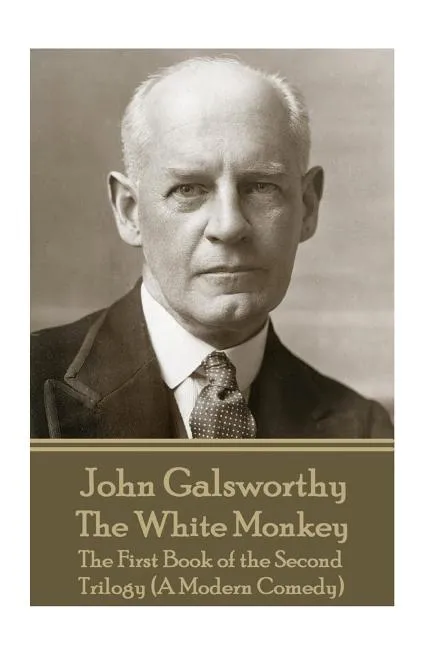
John Galsworthy - The White Monkey
The First Book of the Second Trilogy (A Modern Comedy)
Report an issue
Tell us what's wrong and we'll take a look.
Thanks – we got it. We'll review and follow up if needed.
John Galsworthy was born at Kingston Upon Thames in Surrey, England, on August 14th 1867 to a wealthy and well established family. His schooling was at Harrow and New College, Oxford before training as a barrister and being called to the bar in 1890. However, Law was not attractive to him and he travelled abroad becoming great friends with the novelist Joseph Conrad, then a first mate on a sailing ship. In 1895 Galsworthy began an affair with Ada Nemesis Pearson Cooper, the wife of his cousin Major Arthur Galsworthy. The affair was kept a secret for 10 years till she at last divorced and they married on 23rd September 1905. Galsworthy first published in 1897 with a collection of short stories entitled "The Four Winds". For the next 7 years he published these and all works under his pen name John Sinjohn. It was only upon the death of his father and the publication of "The Island Pharisees" in 1904 that he published as John Galsworthy. His first play, The Silver Box in 1906 was a success and was followed by "The Man of Property" later that same year and was the first in the Forsyte trilogy. Whilst today he is far more well know as a Nobel Prize winning novelist then he was considered a playwright dealing with social issues and the class system. Here we publish Villa Rubein, a very fine story that captures Galsworthy's unique narrative and take on life of the time. He is now far better known for his novels, particularly The Forsyte Saga, his trilogy about the eponymous family of the same name. These books, as with many of his other works, deal with social class, upper-middle class lives in particular. Although always sympathetic to his characters, he reveals their insular, snobbish, and somewhat greedy attitudes and suffocating moral codes. He is now viewed as one of the first from the Edwardian era to challenge some of the ideals of society depicted in the literature of Victorian England. In his writings he campaigns for a variety of causes, including prison reform, women's rights, animal welfare, and the opposition of censorship as well as a recurring theme of an unhappy marriage from the women's side. During World War I he worked in a hospital in France as an orderly after being passed over for military service. He was appointed to the Order of Merit in 1929, after earlier turning down a knighthood, and awarded the Nobel Prize in 1932 though he was too ill to attend. John Galsworthy died from a brain tumour at his London home, Grove Lodge, Hampstead on January 31st 1933. In accordance with his will he was cremated at Woking with his ashes then being scattered over the South Downs from an aeroplane.
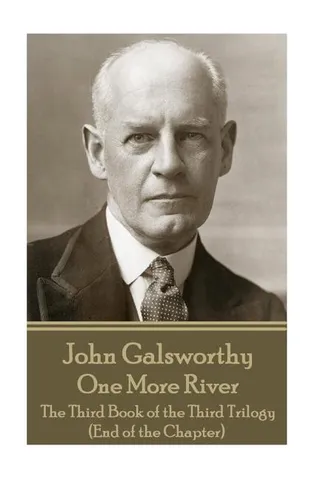
John Galsworthy
John Galsworthy OM was an English dramatist and novelist who lived from 14 August 1867 to 31 January 1933. His novels, The Forsyte Saga, and two more trilogies, A Modern Comedy and End of the Chapter, are his best-known works. He received the Nobel Prize in Literature in 1932. Galsworthy, who came from a wealthy upper-middle-class family, was expected to become a lawyer, but he found the profession unappealing, so he resorted to literature. Before his first book, The Man of Property, about the Forsyte family, was released in 1897, he was thirty years old. It wasn't until that book-the first of its kind-that he saw true popularity. His debut play, The Silver Box, had its London premiere the same year. As a writer, he gained notoriety for his socially conscious plays that addressed issues such as the politics and morality of war, the persecution of women, the use of solitary confinement in prisons, the battle of workers against exploitation, and jingoism. The patriarch, Old Jolyon, is based on Galsworthy's father, and the Forsyte family in the collection of books and short tales known as The Forsyte Chronicles is comparable to Galsworthy's family in many aspects.
More by John Galsworthy





Why Readwise Books?
Readwise Books is an ebook & audiobook platform that automatically logs how much you and your friends read, making it fun and easy to read more. Learn more →