Report an issue
Tell us what's wrong and we'll take a look.
Thanks – we got it. We'll review and follow up if needed.
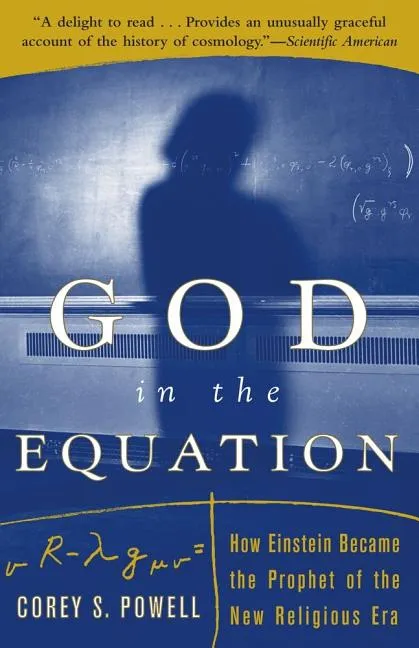
He wanted to know where our world comes from and where it was going.
He wanted to understand how the remote stillness of the heavens relates to the erratic, ever-changing events here on earth.
Above all, he wanted to know if the answers to these questions would bring him closer to a higher authority.
So Einstein put God in the Equation
"Everyone who is seriously involved in the pursuit of science," Albert Einstein once said, "becomes convinced that a spirit is manifest in the laws of the universe -- a spirit vastly superior to that of man." This mysterious component, which Einstein called a "cosmological constant," would eventually work its way into his world-shattering theory of relativity. In this way, explains acclaimed science writer Corey S. Powell, Einstein was creating a formula for a new kind of "sci/religion," one in which God was a factor, denoted by the Greek letter Lambda, and one that would pave the way for an entirely new gnostic era in the history of human spirituality.
Corey Powell
Corey S. Powell is the former editor in chief of American Scientist and Discover, where he is currently editor at large and continues to write the "Out There" column and blog. He is also a visiting scholar at NYU's SHERP science journalism program, as well as a freelance writer for Popular Science, Smithsonian, Nautilus, and Aeon; his article "The Madness of the Planets" appears in The Best American Science and Nature Writing 2014. He lives in Brooklyn with his wife, two daughters, and a small collection of Permian-era fossils. He has collaborated with Bill Nye on Undeniable and Unstoppable.











Why Readwise Books?
Readwise Books is an ebook & audiobook platform that automatically logs how much you and your friends read, making it fun and easy to read more. Learn more →